Meningkatkan Setiap Pakaian

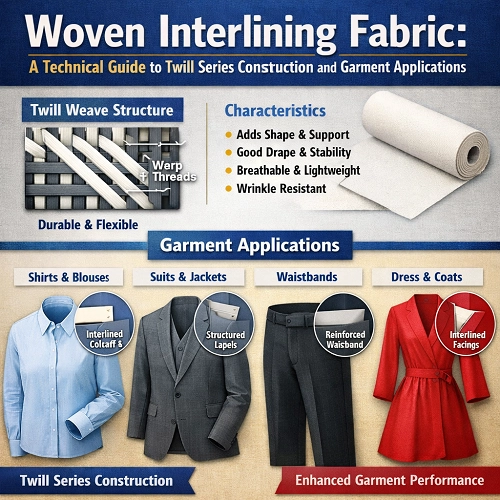
Woven interlining fabric is a structured textile layer bonded or sewn to the underside of an outer fabric to reinforce specific garment zones — collars, front panels, waistbands, plackets, sleeves, and pocket openings. Unlike non-woven alternatives, a woven interlining is constructed on a loom, giving it directional strength, controlled drape, and a consistent thread-count density that closely mirrors the behaviour of the shell fabric above it.
The interlining market divides broadly into woven interlining, non-woven interlining, hair canvas interlining, and needle punch felt. Woven constructions occupy the premium tier, offering dimensional stability that non-woven substrates cannot match in tailored applications.
A twill weave passes each weft thread over one or more warp threads and then under two or more, advancing one step with each pick to create a diagonal rib. Compared with a plain weave, twill constructions deliver greater fabric density per unit area, improved yarn mobility, and a smoother surface — all of which translate directly into enhanced bonding consistency when adhesive coatings are applied.
The Twill Fabric Series 7 catalogue from Jiaxing Rainbow (UBL) includes two distinct twill architectures: Twill 2/2 (balanced, floating equally over and under two threads) and Twill 3/1 (the weft floats over three and under one, producing a pronounced diagonal and a denser face). The 3/1 construction concentrates more fibres at the surface, adding body to heavier interlining weights and making it preferable for structured outerwear such as overcoats and trench coats.
| Property | Plain Weave | Twill 2/2 | Twill 3/1 |
|---|---|---|---|
| Diagonal rib visibility | None | Moderate | Pronounced |
| Fabric density | Moderate | High | Very High |
| Surface smoothness | Moderate | High | Very High |
| Drape flexibility | Stiff | Balanced | Fluid for weight |
| Best application | Light shirts, blouses | Jackets, suits | Overcoats, trench coats |
| Typical weight range (g/m²) | 14–55 | 22–145 | 22–145 |
Source: Compiled from interlining-factory.com — Twill Fabric Series 7 specification table.
The foundational yarn in the Twill Fabric Series 7 is high-elastic semi-gloss DTY (Draw Textured Yarn), a polyester filament that has been heat-drawn and texturised to introduce controlled crimp and stretch. The semi-gloss finish moderates the natural sheen of fully bright polyester, yielding a surface that photographs neutrally and accepts dyestuffs evenly.
The series spans a yarn specification range from 20D × 20D (ultra-lightweight, for finely woven silk and voile-weight shell fabrics) up to 100D × 300D (heavyweight, for wool-blend and thick polyester-viscose shells). The table below maps key model codes against their yarn specifications and structural variant.
| Model | Weight (g/m²) | Yarn Spec (warp × weft D) | Weave Structure |
|---|---|---|---|
| H7761 | 22 | 20D × 20D | Twill 2/2 |
| H7762 | 30 | 30D × 30D | Twill 2/2 |
| H7763 | 45 | 50D × 50D | Twill 2/2 |
| H7765 | 55 | 75D × 75D | Twill 2/2 |
| H7767 | 75 | 75D × 150D | Twill 2/2 |
| H7769 | 95 | 100D × 300D | Twill 2/2 |
| H7771 | 115 | 100D × 300D | Twill 2/2 |
| H7773 | 135 | 100D × 300D | Twill 2/2 |
| H7741 | 22 | 20D × 20D | Twill 3/1 |
| H7745 | 55 | 75D × 75D | Twill 3/1 |
| H7749 | 95 | 100D × 300D | Twill 3/1 |
| H7754 | 145 | 100D × 300D | Twill 3/1 |
Source: Jiaxing Rainbow (UBL) — Twill Fabric Series 7 specification table.
All fabrics in the series are woven on a water-jet loom. In water-jet weaving, a high-pressure jet of water propels the weft yarn across the shed. The process is faster than shuttle-based weaving, produces minimal mechanical stress on the yarn, and yields a tighter, more uniform fabric surface — an important factor when applying subsequent coating layers. Water-jet looms are particularly efficient with smooth, hydrophobic polyester filaments, making them the industry-standard choice for high-volume interlining production.
After weaving, grey fabric undergoes high-temperature dyeing — typically conducted in pressurised jet dyeing machines at temperatures between 120 °C and 135 °C for polyester. This process serves two functions simultaneously: it drives disperse dye molecules deep into the polyester crystalline structure (producing consistent, wash-fast colouration), and the elevated temperature relaxes internal yarn stresses, stabilising fabric dimensions before the coating stage.
Standard colour offerings for interlining production are white, off-white, and black — neutrals chosen to avoid tonal bleed through translucent shell fabrics. Custom shades are available on request from the Jiaxing Rainbow (UBL) team.
The adhesive interface is the most performance-critical element of any fusible interlining. The Twill Fabric Series 7 employs double-dot coating with high-performance PA (polyamide) adhesive powder.
In a double-dot system, a paste base dot is first printed onto the fabric surface; PA adhesive powder is then scattered over the wet paste. The paste dot holds the powder bead in precise position and controls dot height, while leaving clear channels of uncoated fabric between dots. This geometry achieves three objectives simultaneously:
Polyamide adhesives offer a melting range that sits comfortably within standard industrial fusing press temperatures (120–150 °C), excellent resistance to dry-cleaning solvents, and adequate wash resistance at temperatures up to 40 °C. Their relatively low melt viscosity at fusing temperature promotes good wetting of the shell fabric yarns, producing a durable mechanical bond even on densely woven or coated shell materials.
Correct fusing is as important as interlining quality itself. The published fusing window for the Twill Fabric Series 7 is:
| Parameter | Recommended Range | Notes |
|---|---|---|
| Temperature | 120 °C – 140 °C | Adjust for sensitive shell fabrics (e.g. silk: lower end) |
| Time | 12 s – 15 s | Continuous belt fusing press; extend slightly for heavyweight shells |
| Pressure | 1.5 – 2.5 kg/cm² | Ensure even platen contact; avoid over-pressure on delicate weaves |
Source: Jiaxing Rainbow (UBL) — Twill Fabric Series 7. Always conduct a fusing trial on the specific shell fabric before production.
One of the defining commercial strengths of the Twill Fabric Series 7 is its broad shell fabric compatibility. The PA adhesive system performs reliably across a wide range of fibre types and finishes:
| Shell Fabric Type | Recommended Weight (g/m²) | Suggested Structural Zone |
|---|---|---|
| Silk & silk-blend | 14 – 30 | Collar, placket, cuffs |
| Cotton & cotton-blend | 22 – 55 | Front panel, collar, waistband |
| Polyester-cotton | 22 – 65 | Front panel, sleeve, pockets |
| Polyester-viscose | 30 – 75 | Collar, lapel, jacket front |
| Chemical fibres (general) | 22 – 85 | Reinforcement areas, placket |
| Wool & wool-blend | 55 – 145 | Overcoat front, collar, back-neck stay |
From a garment construction standpoint, the series supports the full range of structured apparel: jackets, windbreakers, trench coats, overcoats, and suits. For lighter formalwear, it can also perform in the collar and waistband of petticoats and dress jackets.
A recurring concern among garment manufacturers is interlining delamination after repeated laundering. The double-dot PA coating used in the Twill Fabric Series 7 maintains bond integrity through both washing (hand wash and machine wash at appropriate temperatures) and professional dry cleaning. The key variables that preserve bonding longevity are:
Jiaxing Rainbow (UBL) Interlining Co., Ltd is a specialist manufacturer and wholesale exporter of interlining fabrics headquartered in Jiashan County, Jiaxing, Zhejiang Province, China. The company operates additional production facilities in Wannian County, Shangrao, Jiangxi, China, and maintains an overseas presence through Leaf Apparel Solutions in Dhaka, Bangladesh. This multi-site structure enables responsive lead times for customers across Asia, Europe, and the Americas.
The company's full product portfolio encompasses woven interlining (plain fabric, twill fabric, tricot, and knitting series), non-woven interlining (nylon, nylon-polyester mixed, and polyester variants), special interlinings including enzyme-wash, PU coating, and GRS recycled constructions, hair canvas interlining for bespoke tailoring, and needle punch felt accessories such as under-collar felt, chest felt, and sleeve heads.
Quality assurance covers the full production chain — from raw fibre sourcing and loom calibration through to coating uniformity checks and adhesive bond testing — as detailed on the company's advantage and quality assurance page.
Plain-weave interlinings (see also the Plain Fabric Series 7) remain the workhorse of the industry for lightweight and semi-structured applications. The economic and technical case for upgrading to twill construction centres on three factors.
First, twill's diagonal structure distributes stress along a longer yarn path, which improves tear resistance at structural seam junctions — especially at collar attachment seams and armhole edges where dynamic stress is highest. Second, the smoother surface of a twill interlining slides more easily against lining fabrics, reducing internal garment friction and improving wearer comfort in tailored outerwear. Third, the denser weave of a twill construction provides a more consistent anchor for the double-dot adhesive pattern, resulting in more uniform peel-strength measurements across the fabric width.
Woven twill interlining fabric represents a mature but technically sophisticated product category where small differences in yarn specification, weave architecture, and coating chemistry translate into meaningful differences in garment quality and longevity. The Twill Fabric Series 7 from Jiaxing Rainbow (UBL) addresses this complexity with a graduated weight range from 14 g/m² to 145 g/m², two twill structures (2/2 and 3/1), and a standardised double-dot PA coating system validated against a broad spectrum of shell fabrics.
Buyers evaluating interlining suppliers should request sample sets across the intended weight range, conduct fusing trials on production shell fabrics using the recommended parameters, and evaluate post-wash peel strength before finalising specifications. For samples, technical data sheets, or custom development, the Jiaxing Rainbow (UBL) sales team can be reached through the contact page.